


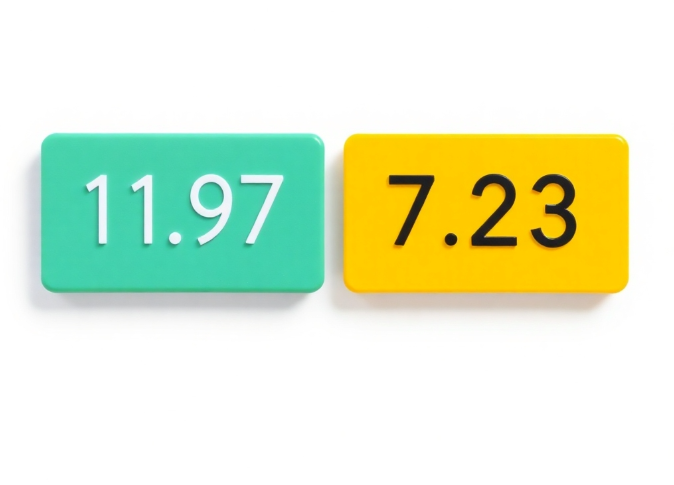
When we talk about numbers like 11.97 and 7.23, we’re looking at two distinct values that can have various implications depending on the context. These values, when compared, show us their what is the difference between 11.97 and 7.23 in terms of their numerical size and magnitude. Understanding how to calculate and interpret the difference between these two values, while also analyzing their significance in different contexts, is a useful exercise.
Let’s first break down the basic difference between these two numbers:
1. Basic Calculation of the Difference
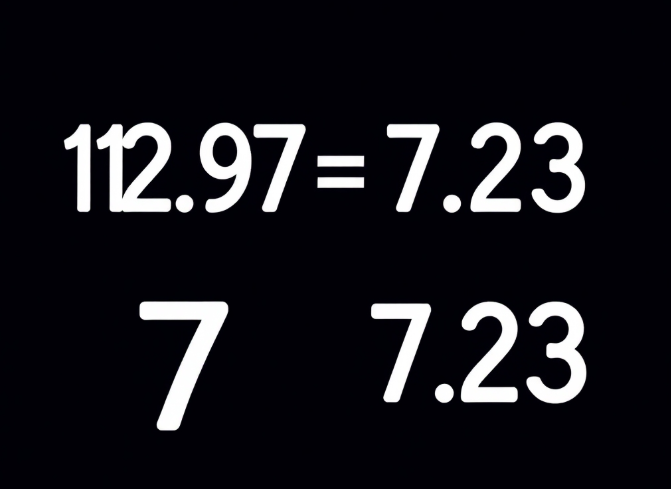
To calculate the difference between 11.97 and 7.23, we subtract the smaller number (7.23) from the larger number (11.97):11.97−7.23=4.7411.97 – 7.23 = 4.7411.97−7.23=4.74
So, the difference between 11.97 and 7.23 is 4.74. This means that 11.97 is 4.74 units greater than 7.23.
2. Significance in Different Contexts
A. Mathematical Context
In mathematics, the difference between two numbers is a fundamental concept. The what’s the difference between 11.97 and 7.23 could represent anything from a financial disparity to a change in measurements. When comparing two values in mathematical operations, this difference helps in understanding how far apart the values are in terms of magnitude.
B. Scientific Context
In the field of science, precision is key. If the numbers represent measurements, for instance, 11.97 could be the mass of a substance in grams, while 7.23 could represent the volume of a liquid in milliliters. what is the diffrence of 11.97 and 7.23 may be used to determine additional parameters like concentration, density, or other physical properties.
C. Financial Context
In finance, numbers like 11.97 and 7.23 could represent stock prices, costs, or profits. A difference of 4.74 could indicate a price fluctuation or a change in value over time. This could be the result of market dynamics, investment strategies, or changes in company performance.
D. Statistical Context
In statistics, understanding the difference between values is crucial for analyzing data sets, calculating deviations, and making predictions. In this case, the difference of 4.74 could indicate a significant difference between two data points or samples, and might be used in hypothesis testing, data normalization, or for calculating statistical measures like the mean, variance, or standard deviation.
3. Conversion and Analysis
Let’s explore how these numbers would look in different metric systems and how to evaluate them across different fields.
| Metric | Value |
|---|---|
| Difference | 4.74 |
| 11.97 (larger) | 11.97 |
| 7.23 (smaller) | 7.23 |
A. In Percentage Terms
You can also express the difference as a percentage. To find what percentage the difference of 4.74 is in relation to the smaller number (7.23), use the following formula:Percentage Difference=(4.747.23)×100=65.6%\text{Percentage Difference} = \left( \frac{4.74}{7.23} \right) \times 100 = 65.6\%Percentage Difference=(7.234.74)×100=65.6%
So, the difference between 11.97 and 7.23 is 65.6% of the smaller value (7.23).
B. In Absolute Terms
Another way to interpret the difference is in absolute terms, where it simply quantifies how much larger or smaller one value is compared to the other without considering percentages. As previously mentioned, the absolute difference between 11.97 and 7.23 is simply 4.74.
4. Visualizing the Difference
To make the comparison even clearer, let’s visualize the difference:
- 11.97 is clearly larger than 7.23, and the space between them (the difference) is 4.74.
- On a number line, we would have the two values represented at two points, and the distance between them would measure 4.74.
5. Conclusion
The difference between 11.97 and 7.23 is 4.74. This calculation is straightforward, but its application can vary significantly depending on the context in which these numbers are used. Whether it’s for mathematical analysis, financial reporting, or scientific measurement, understanding the significance of the difference between two numbers is critical in drawing meaningful conclusions and making informed decisions.
By breaking down the calculation and applying it across different fields, we get a deeper understanding of the number’s implications and how they might be used practically.
Quick Recap
| Metric | Value |
|---|---|
| First Value | 11.97 |
| Second Value | 7.23 |
| Difference | 4.74 |
| Percentage Difference | 65.6% |
This analysis highlights how understanding basic operations and interpreting differences can be useful in diverse fields.

