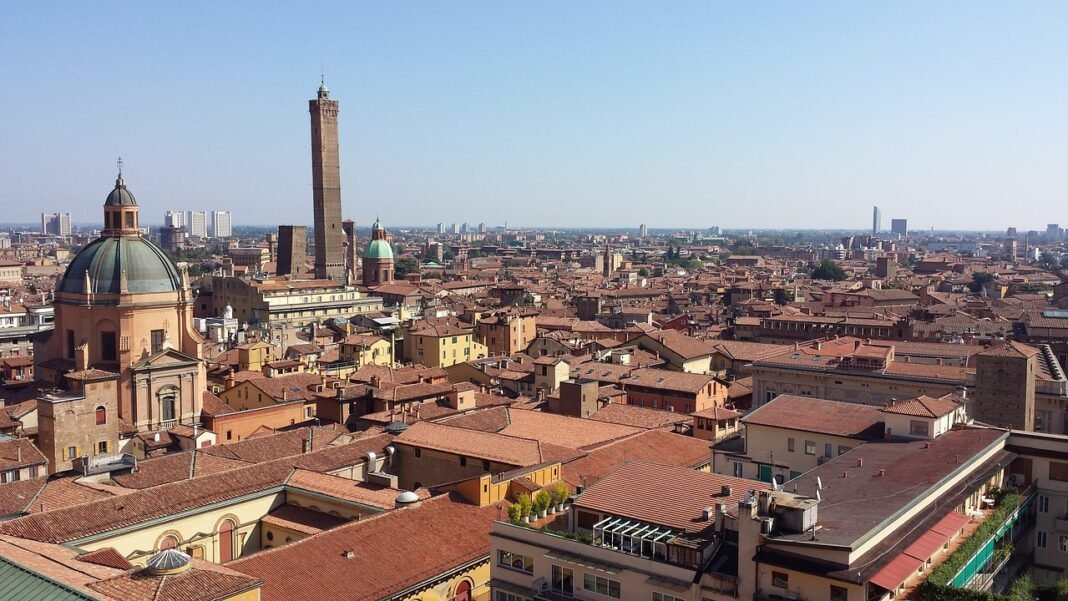

Among the various cities and towns in Italy, Bologna holds a special place in the heart of those who know Italy well. It is often overshadowed by Florence and Rome, but as a lifelong Bolognese resident, I’ve watched countless visitors fall under the spell of what we locals affectionately call “la dotta, la grassa, la rossa” (the learned, the fat, the red).
The Ancient Heart of Learning
Bologna is home to the University of Bologna, established in 1088 and widely recognized as the oldest university in continuous operation in the world. This venerable institution has shaped the city’s character for nearly a millennium, earning Bologna its first nickname, “la dotta” (the learned).
Walking through the university quarter, you’ll feel the intellectual energy that has attracted scholars for centuries. Visit the Archiginnasio, the university’s magnificent former main building, where you can explore the Anatomical Theatre, a 17th-century wooden amphitheater where anatomy lessons were once conducted. The walls and ceilings throughout the building are adorned with thousands of heraldic emblems of past students and professors, creating a visual testament to centuries of scholarship.
The university’s influence extends beyond its historic buildings. It infuses the entire city with a youthful vibrancy, as students from across Italy and around the world fill its streets, cafes, and piazzas.
A Gastronomic Paradise
Bologna’s second nickname, “la grassa” (the fat), celebrates its extraordinary culinary heritage. The city is the capital of Emilia-Romagna, a region renowned throughout Italy and beyond for its exceptional food.
The authentic Bolognese cuisine might surprise visitors familiar only with international interpretations. Take, for example, the famous ragù alla bolognese. Here, we never serve it with spaghetti (that’s a foreign invention!), but rather with tagliatelle, fresh egg pasta cut into ribbons. Other local treasures include tortellini in brodo (small stuffed pasta served in broth), mortadella (the original Bologna “bologna”), and lasagne verdi al forno (green lasagna baked with ragù and béchamel).

For the cultural explorer, understanding Bologna means engaging with its food culture. Visit the medieval market streets of the Quadrilatero, where narrow alleyways are lined with vendors selling fresh pasta, aged cheeses, cured meats, and seasonal produce. Stop at a traditional osteria to experience unhurried, multi-course meals accompanied by local wines like Sangiovese or Pignoletto.
The City of Porticoes
Bologna’s distinctive porticoes, covered walkways supported by columns that line the streets, are more than an architectural feature; they’re a way of life and have recently been recognized as a UNESCO World Heritage site. Stretching for nearly 40 kilometers throughout the city, these porticoes date back to the Middle Ages and represent a unique urban solution that has shaped Bologna’s character.
Originally built to extend living spaces in medieval buildings, the porticoes now provide shelter from rain and sun, creating comfortable spaces for shopping, dining, and socializing regardless of the weather. Each section has its own personality, from the elegant porticoes of Via Farini with its luxury shops to the humble, wooden structures of Via Piella.
The most ambitious is the Portico di San Luca, a 3.8-kilometer covered walkway leading from the city gates up to the Sanctuary of the Madonna di San Luca on a hill overlooking Bologna. With 666 arches, it’s a remarkable architectural achievement and a popular pilgrimage route that offers breathtaking views of the countryside.
La Rossa: The Red City
Bologna’s third nickname, “la rossa” (the red), has dual significance. It refers both to the distinctive terracotta rooftops and brick buildings that give the cityscape its warm, reddish hue, and to Bologna’s historical political leanings as a stronghold of progressive politics.
The city’s revolutionary spirit has deep roots. During World War II, Bologna was a center of resistance against fascism. This independent, sometimes rebellious character remains an integral part of Bologna’s identity and can be felt in its vibrant contemporary arts scene and community initiatives.
Hidden Gems Beyond the Tourist Trail
One of Bologna’s greatest charms is how it rewards the curious explorer who ventures beyond the main attractions. We recommend visiting the city’s “secret” window on Via Piella, which offers a glimpse of Bologna’s hidden canals, remnants of a more extensive waterway system that once earned Bologna comparisons to Venice.
Visit the Seven Churches of Santo Stefano, a fascinating religious complex where structures from different periods fuse together in an architectural dialogue spanning centuries. Or explore the former Jewish Ghetto, with its narrow streets and unexpected courtyards, for a glimpse into a different layer of Bologna’s complex history.
Contemporary Culture in a Historic Setting
While Bologna treasures its past, it’s no museum piece. The city boasts a thriving contemporary art scene, with galleries like MAMbo (Museum of Modern Art Bologna) showcasing cutting-edge works in a converted bakery. The annual Bologna Jazz Festival attracts world-class musicians, while film enthusiasts can explore the Cineteca di Bologna, one of Europe’s most important film archives.

The city’s relationship with street art and graffiti is particularly interesting. While preserving its historic beauty, Bologna also provides space for urban artistic expression, creating a dialogue between tradition and innovation that reflects the city’s progressive spirit.
A Perfect Base for Regional Exploration
Bologna’s strategic location in northern Italy makes it an ideal base for exploring the wider Emilia-Romagna region. Day trips can take you to Modena (home of balsamic vinegar and Ferrari), Parma (famous for its prosciutto and cheese), or Ravenna (with its extraordinary Byzantine mosaics).
The region’s gently rolling hills, dotted with vineyards and small medieval towns, offer a different pace from city life and insight into rural Italian traditions that remain vibrant today.
The Bolognese Way of Life
Perhaps what makes Bologna most special is the quality of life it offers. Neither as tourist-crowded as Florence nor as fashion-conscious as Milan, Bologna maintains an authenticity that allows visitors to experience real Italian city life.
Locals still observe the tradition of the passeggiata (evening stroll), enjoy long conversations in piazzas, and take time for proper meals. This unhurried approach to daily life, combined with the city’s rich cultural offerings, creates an environment where cultural explorers can do more than simply see Bologna.